The Iran war is spreading misery around the world, starting with the most vulnerable places. Sirantos Fotopoulos argues that the source of the war—and of the misery—is the system of energy-for-profit. The present catastrophe was not inevitable in the sense that the laws of nature made it so. It was inevitable in the sense that the laws of capital made it so.
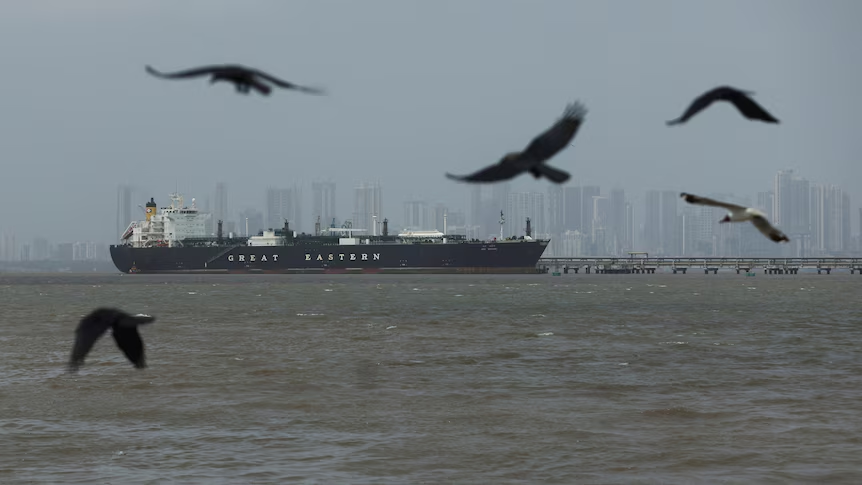
Sirantos Fotopoulos || Through Hormuz flows approximately one-fifth of all the oil that lubricates the engines of global capitalism. It also carries a third of the world’s liquefied natural gas, a third of its fertilizer trade, the sulfur that processes metals, and the helium that manufactures semiconductors. It is the circulatory system of the modern world economy—and it is now essentially closed for three weeks with no predictable opening in sight.
Brent crude surpassed one hundred dollars per barrel on the eighth of March and rose to $126 at its peak—the fastest price surge in any conflict in recorded history. Iraq’s Rumaila oil field, one of the largest on Earth, shut down operations because the tankers could not leave the strait and the storage tanks filled to capacity. Production continued until the physical circulation of commodities became impossible. Capital accumulated in steel containers in the desert. Marx described this with cold precision over a century and a half ago: The crisis in which the forces of production outrun the social relations through which they are distributed, and the whole machinery of accumulation seizes.
The models are now in, and they do not require interpretation. An extended closure raises oil to $132 dollars per barrel or more and subtracts from global real GDP growth at annualized rates that guarantee recession in every economy dependent on Hormuz for fuel—which is to say, most of them. Forty percent of China’s oil imports pass through that strait. India faces what its own energy ministry has called an acute crisis, as its population depends on Gulf LNG not merely to power industry but to cook food. Pakistan and Bangladesh source virtually all of their liquefied natural gas from Qatar and the UAE. The closure of Hormuz translates, in the periphery of the world system, into cold stoves, shuttered factories, and the kind of unemployment that does not appear in Goldman Sachs projections but does appear, with reliable punctuality, in the form of riots.
And Goldman Sachs tells us that the United States faces an increase in recession probability, perhaps by five percentage points. This statistic is instructive not for what it reveals but for what it conceals. The United States is a net oil exporter. Its domestic shale production insulates it from the immediate price shock in ways that no South Asian or East African economy can replicate. The immiseration cascading through the Global South is, from the perspective of Wall Street, essentially a rounding error—an externality, to use the preferred euphemism of a discipline that has always been more ideology than science. What this framing omits, with the practiced incuriosity of a class that has never gone without, is that the workers and the poor of the world periphery will absorb costs they did not choose, for a war they did not start, in service of interests that bear no relation to their own.
This is the geography of capitalism’s crises made visible. They are not distributed according to where they originate; they migrate, with the unerring instinct of water finding its level, toward wherever the least power exists to resist them. Marx understood this. He called it the world market, and he understood that its formation was capitalism’s greatest achievement and its most dangerous vulnerability simultaneously—the mechanism by which a crisis anywhere becomes a crisis everywhere, but one whose costs are borne everywhere unequally.
The power to decide who gets the oil
The United States is a net oil exporter. It does not need the petroleum of the Persian Gulf for its own consumption. And yet it has committed its military power to controlling that petroleum since at least 1980, when the Carter Doctrine announced that the free flow of oil from the region was a vital national interest worth defending by force. The question of why a country that does not need the oil should spend trillions of dollars and hundreds of thousands of lives to control its distribution has a simple answer that the foreign policy establishment finds socially unacceptable to state plainly: because controlling the conditions under which your rivals and allies obtain their energy is the infrastructure of imperial hegemony. By remaining the military guarantor of Gulf security, Washington retains leverage over China, Japan, South Korea, and Europe—all of whom depend on Hormuz to function. The United States does not need the oil. It needs to be the power that decides who gets the oil. That is the difference between a nation-state and an empire.
Iran’s closure of the strait is therefore not simply military retaliation. It is, whatever its ideological dressing, an asymmetric strike at the capillary infrastructure of American imperial accumulation—the first serious challenge to the physical architecture of dollar hegemony since Nixon’s 1973 deal with the House of Saud. The Islamic Revolutionary Guard Corps, that repressive instrument of a theocratic ruling class, has stumbled into performing a structural function that no bourgeois competitor of the United States has dared attempt: threatening to sever the arteries through which Washington extracts its imperial premium from the world economy. One need not admire the theocracy to recognize the significance of this.
The inter-imperialist contradictions exposed by the closure deserve particular attention because they are being sanitized out of the mainstream account. Vladimir Putin is, in the near term, a beneficiary of this crisis. Every dollar added to the crude price eliminates the discount penalty on Russian oil and increases the revenue of the Russian petrostate. The Trump administration has been compelled, by the logic of its own intervention, to ease restrictions on Russian oil shipments in order to prevent prices from spiraling beyond political tolerance. The architects of Operation Epic Fury, the self-styled avengers of Western civilization are functionally subsidizing the Russian war economy as a downstream consequence of their own campaign. The closure of Hormuz … is precisely the variety of crisis that capitalism’s standard instruments of management … cannot address.
Marx wrote of recurring crises not as accidents but as the systemic expression of capitalism’s internal contradictions—specifically, the tendency of the rate of profit to fall as the organic composition of capital rises, and the periodic necessity of destroying accumulated value to restore the conditions for renewed accumulation. What is unfolding now is a crisis of this character, accelerated and externalized through the mechanisms of imperial military competition. The closure of Hormuz functions as what economists call a supply-side shock, which is precisely the variety of crisis that capitalism’s standard instruments of management—monetary easing, fiscal stimulus, quantitative anything—cannot address. You cannot print your way out of the Hormuz bottleneck. You cannot lower interest rates to restore the flow of Qatari LNG. The tools are wrong for the problem because the problem is not monetary. It is material.
Stagflation—the simultaneous occurrence of rising prices and contracting output—is capitalism’s most politically destabilizing crisis configuration because it delegitimizes both available remedies at once. Raise rates to fight inflation and you accelerate the recession. Stimulate to fight the recession and you accelerate the inflation. The working class, which has no hedge fund, no commodity futures contract, no offshore account, and no political action committee, absorbs the full impact of both movements simultaneously: the erosion of real wages by rising energy and food costs, and the unemployment generated by contracting output. The rentier class, which owns the oil companies whose valuations are presently soaring, is having an excellent quarter.
A preventable crisis
The obscenity of this moment lies not merely in its human cost—though the human cost, particularly in the periphery, is already catastrophic and will grow—but in its utter preventability. Not preventable in the sense that this particular war could have been avoided by this or that diplomatic maneuver, though that may also be true. Preventable in the deeper structural sense: a world in which the metabolic sustenance of billions of people—their energy, their food, their warmth—is routed through a twenty-one-mile wide strait contested by empires, and available for closure by any sufficiently motivated military force, is a world organized for catastrophe. The chokepoint is the consequence of an economic system that has never organized the provision of energy as a human need and has always organized it as a source of profit and, by extension, of power.
The ownership structure of global energy is the central political fact of the modern world. Seven major Western oil corporations, a handful of Gulf sovereign wealth funds operating as de facto instruments of autocratic dynasties, and the Russian state-corporate energy complex between them control the production and distribution of most of the world’s hydrocarbons. The pricing of these hydrocarbons is performed in dollars, intermediated by American financial institutions, and ultimately backstopped by the American military’s willingness to project force into regions where this arrangement is contested. The benefits of this arrangement flow to shareholders, to sovereign wealth funds, to the financial sector, and to the imperial states. The costs flow to the working class—in fuel poverty, in petro-wars, in the climate consequences of an industry that has spent fifty years suppressing the science of its own destructiveness, and now, in this crisis, in the immiseration of hundreds of millions of people who have no relationship to the conflict and no stake in its outcome. The [Hormuz] chokepoint is the consequence of an economic system that has never organized the provision of energy as a human need.
Let us now speak of what could have been—and what yet might be. Because the argument for public ownership of natural resources is not a philosophical disposition. It is, at this moment, the only rational conclusion available to anyone who has been paying attention. The evidence is not contested. It is simply suppressed, ridiculed, and buried under decades of market ideology so thoroughly internalized that even its victims have learned to recite it.
Consider Norway. In 1969, oil was discovered beneath the North Sea, and the Norwegian state faced the same choice that every resource-rich nation has faced and most have answered badly: Cede the resource to private capital in exchange for royalties and investment, or assert democratic ownership on behalf of the population. Norway chose ownership. Equinor—majority state-owned—extracts the oil, and the revenues flow into the Government Pension Fund, now valued at over a trillion dollars, the largest sovereign wealth fund on Earth. Every Norwegian citizen is, in a meaningful sense, a beneficial owner of their nation’s hydrocarbons. The fund finances public services, public infrastructure, the energy transition, and a standard of living that no amount of trickle-down theology has ever produced for a working population anywhere that left the extraction in private hands. Norway does not have energy poverty. It does not have a population held hostage to the price decisions of a board of directors in Houston or London. It made a different choice, and the difference is measurable in human lives.
Consider Bolivia under Evo Morales. In 2006, the state renationalized the natural gas sector—sending the army to occupy the fields, expropriating the foreign concessions, and directing revenues through the public treasury. Between 2006 and 2014, Bolivia recorded the most dramatic reduction in poverty in its modern history. The poverty rate fell from 66 percent to 39 percent. Child malnutrition declined. Public healthcare expanded into regions that private capital had never found it profitable to serve. The IMF, that institutional enforcer of the Washington Consensus, watched with the expression of a priest witnessing a successful exorcism and declared the results an anomaly. They were not an anomaly. When the surplus generated by a natural resource belongs to the population rather than to shareholders, the population benefits.
Consider Ecuador, which directed resource revenues through public institutions rather than foreign concessions under the Correa government, funding the most extensive infrastructure investment in the country’s history: roads, hospitals, universities, hydroelectric plants. Consider Mexico’s PEMEX, however mismanaged and corrupted by successive governments, which nonetheless financed decades of public spending that private oil would have routed to offshore accounts. Consider the Alaska Permanent Fund—a rare American instance of resource sovereignty, under which every Alaskan resident receives an annual dividend from oil revenues. The principle is identical across every case: when the people own the resource, the returns from the resource can be directed toward human needs. When private capital owns the resource, the returns are directed toward capital accumulation, which is a different thing entirely and serves a different class entirely.
Capitalism doesn’t just fail us. It endangers us.
Now extend the principle beyond oil to the industrial commanding heights—the steel mills, the shipping companies, the refineries, the grid infrastructure—and the argument becomes not merely economic but civilizational. An economy in which the fundamental means of production are organized as democratic public utilities, governed in the interest of the populations they serve, directed by planning rather than by the imperatives of quarterly profit, is an economy that can respond to crises as what they are: collective emergencies requiring collective solutions. It can build strategic reserves without asking whether reserves are profitable. It can diversify supply chains without asking whether diversification maximizes return on equity. It can accelerate the transition to renewable energy without asking whether the transition destroys the asset value of existing hydrocarbon infrastructure. Private capital cannot do any of these things because the logic of their position forbids it. They are not paid to serve the public interest. They are paid to serve the shareholder. These are not compatible mandates, and pretending otherwise is the ideological work of a ruling class that requires the confusion to continue.
And here is the stark and simple truth that this crisis has written in crude oil across the face of the global economy: The private ownership of energy does not merely fail the people. It endangers them. It creates, with the inevitability of a law of physics, the conditions for exactly the catastrophe we are now watching unfold. When oil belongs to corporations whose pricing decisions are made in the interest of shareholders, the price of oil becomes a weapon. When oil is routed through imperial chokepoints backstopped by military power, the chokepoints become targets. When the energy supply of billions of people is organized as a profit center rather than as a public utility, those billions of people become, in the most precise sense of the word, hostages—held by the market in peacetime and by military geography in wartime, with no distinction between the two conditions that would be legible to anyone actually running out of fuel.
The present catastrophe was not inevitable in the sense that the laws of nature made it so. It was inevitable in the sense that the laws of capital made it so. An energy system privately owned, imperially defended, and routed through contested military geography will always produce, sooner or later, a moment when private ownership, imperial defense, and contested geography align into crisis. We have arrived at that moment. The question is whether we learn from it or whether we rebuild the same system from the rubble and wait for the next iteration of the same logic to produce the next iteration of the same disaster.
Had the oil of the Persian Gulf been organized as a common resource—governed by international public institutions, priced at cost, distributed on the basis of need, subsidized heavily for all of the world’s poor, with its revenues directed toward the populations of all nations rather than toward the portfolios of foreign shareholders and the treasuries of autocratic dynasties—there would have been no petrodollar system to defend, no imperial premium to extract, no structural incentive for Washington to project military force into the region for half a century, and therefore no Operation Epic Fury, no closed strait, no global recession. This is the logical inversion of everything that actually happened. The private ownership of oil is not merely unjust. It is, as we are now discovering at enormous human cost, incompatible with the stable functioning of a civilization that depends on it for survival.
The workers of the world did not vote for this crisis. They did not choose to route their energy through an imperial chokepoint. They did not consent to a system that makes these decisions for them, above them, and at their expense. They have been told, for fifty years, that the market knows best. The market has just given them its answer: a closed strait, a stagflationary recession, and an energy bill that will consume what remains of their disposable income while the oil corporations book record profits. The alternative: public ownership, democratic control, energy organized as a common good—would not have been perfect. Nothing in the history of human institutions has been perfect. But it would not have been this. It could not have been this, because this is the specific and predictable product of a specific and identifiable set of ownership arrangements.
Discover more from Class Struggle Ecology
Subscribe to get the latest posts sent to your email.