The ecological crisis is not a war between humanity and nature, but a struggle over land, labor, and the conditions of life.
The Ecosocialist || There is an image of nature that still haunts much of environmental thought: Mother Nature as harmony, balance, purity and reconciliation. Nature as the innocent womb that shelters us, as opposed to human society as the realm of disorder, corruption and destruction.
This image is powerful but it is also politically lethal.
It suggests that the ecological crisis comes from “humanity” as such: from human presence, activity and industry as such. From this point of view,the problem is not a specific social order, not a historically determined mode of production, not capital, property, profit, extraction and imperial power. The problem is simply “Man” in general.
This is where a certain ecological sensibility becomes ideological. It turns the ecological crisis into an abstract conflict between “humanity” and the “planet”. Humans become a virus, a cancer, an alien species infecting an otherwise pure Earth. The famous line from Agent Smith in The Matrix — humanity as a disease of the planet — captures this mood perfectly.

But this is not ecology. It is misanthropy with green aesthetics.
The Garden and the Flood
The opposite mistake is not much better. If nature is imagined as something pure and external, ecological politics can easily shrink into private morality. “Consume better”. “Recycle more”. “Buy greener”. “Reduce your footprint”. “Cultivate your garden”.
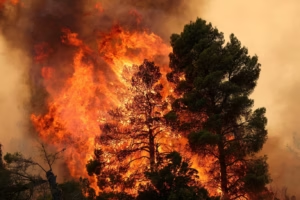
Build a small island of innocence inside a burning world.
Let’s be clear: there is nothing wrong with gardening. There is nothing wrong with care, local communities, small practices of repair, or attempts to live differently. In a world organized by competition, exploitation and exhaustion, these practices can even become forms of dignity and ways of restoring community in a fragmented world. They can open spaces of cooperation and tenderness. They can remind us that another relation to the living world is possible.
A more radical version of the same impulse is the desperate attempt to escape. Civilization appears as corruption, politics as contamination, society as the source of the fall. The answer, then, is withdrawal: retreat into the woods, into communes, into small self-sufficient ecological communities where another life can be preserved. The desire is understandable. But refuge is not transformation. If the world outside continues to organize production through extraction, combustion, land grabbing and war, no small ecological island will remain untouched for long.
The flood will eventually reach even the garden.
Chico Mendes and the Living Forest
None of this, by itself, can stop the immense destructive power of global fossil capital. This is the meaning of the slogan often associated with Chico Mendes: “Environmentalism without class struggle is just gardening”.
Mendes was not an environmentalist in the comfortable sense of the word. He was a Brazilian rubber tapper, trade unionist and socialist from Acre, in the Amazon. He fought for the forest not out of some abstract “love for nature”, but he fought for the people whose lives depended on it: rubber tappers, peasants, Indigenous communities, forest workers.

His struggle was not the defense of an untouched nature against society. It was the defense of a form of life against ranchers, landowners, deforestation, and the organized violence of capital. Mendes defended the Amazon by defending those who lived from the forest without destroying it, and he was assassinated in Xapuri in 1988 exactly for this reason.
This is why the slogan still matters. It does not mean that ecology must be reduced to class politics in a narrow sense.
It means that ecology becomes politically serious only when it asks: who owns the land? Who controls production? Who profits from destruction? Who breathes the poisoned air? Who loses their home to floods, drought, fires, mines, pipelines and plantations? Who is asked to change their lifestyle while fossil companies, agribusiness, militaries and logistics empires reorganize the entire planet for their own profit?
Capital, Not Humanity
The ecological crisis was not produced by “humanity” in the abstract. That abstraction is itself ideological: it allows capital to turn ecological destruction into a shared human failure, rather than the historical outcome of a global social order built on class exploitation, colonial extraction and fossil power.
Responsibility has never been equally distributed. The rich consume and emit far more than the poor; the Global North has accumulated centuries of ecological debt through industrialization, colonial extraction, fossil infrastructures and imperial trade.
To speak of “humanity” in general is therefore to erase the class, colonial and geopolitical structure of ecological destruction.
It was produced through a specific social metabolism: capitalism. A system that transforms forests into timber, soil into yield, rivers into energy, bodies into labor-power, animals into industrial units, and the atmosphere into a free dumping ground.
Marx saw this almost two centuries ago. Capitalist production, he wrote, develops technique and social cooperation only by undermining “the original sources of all wealth: the soil and the worker” (Karl Marx, Capital, Volume I, Chapter XV). That sentence already contains the core of ecosocialism. The exploitation of labor and the exhaustion of nature are not two separate problems. They are two sides of the same historical process.
Capital does not simply dominate nature “outside” us. It dominates the nature that we ourselves are: our bodies, our nerves, our time, our needs, our capacity to breathe, eat, rest, love, think and reproduce life. Nature is not simply the “environment”, nor merely the scenery surrounding society. As Marx wrote in his Manuscripts of 1844: it is the “inorganic body” of human life, the material condition of our existence.
To poison nature is therefore not to damage an external object. It is to contaminate our own body, the very condition for the flourishing of life.
When Metabolism Becomes Robbery
This is what the concept of metabolic rift names: the rupture in the material exchange between human beings and the earth produced by capitalist social relations.
Under capital, our metabolism with nature becomes robbery.
Production becomes extraction. Development becomes exhaustion. What appears as economic growth is often the organized destruction of the conditions that make life possible.
Green capitalism tries to hide this rupture. It tells us that the problem is bad consumption, not the structure of production. It moralizes the individual and leaves power untouched. It turns ecology into a market niche: sustainable brands, ethical lifestyles, carbon offsets, green finance, corporate responsibility reports.
The same system that destroys the world sells us the image of its repair.
The Climate Struggle Beyond Climate
This is also why the most politically lucid strands of climate activism have refused to treat ecology as a separate, single-issue cause. Greta Thunberg’s insistence on linking climate politics to Palestine, war and colonial violence is not a distraction from ecology. It points to the same material truth that Andreas Malm has recently condensed in the title The Destruction of Palestine Is the Destruction of the Earth: the devastation of land, people and the conditions of life is one expression of a world system built on extraction, fossil power and colonial domination.
Slogans such as “system change, not climate change” and “there is no infinite growth on a finite planet” are not merely activist rhetoric. At their best, they grasp something essential: the ecological crisis cannot be repaired without confronting the social order that produces and accelerates it.

The alternative is not between “industrial society” and “ecological purity”, between “politics and nature”, between “human beings” and “the planet”. The real contradiction is between capital and life.
Ecology as Liberation
An ecosocialist politics begins here. It refuses both the fantasy of a pure nature outside history and the fantasy of a green capitalism capable of saving us through better commodities. It understands that every society has a metabolism with nature. The question is who — and which kind of logic —organizes that metabolism, for what purposes, under what relations of power, and according to which idea of life.
Ecology is not a retreat from politics. It is politics at its most material level.
To care for the planet does not mean caring less for people. It means understanding that people and planet are not two separate objects of concern. The struggle for the earth is also the struggle for housing, food, water, health, time, land, freedom and collective power.
Without that struggle, environmentalism becomes a beautiful garden surrounded by fire.
With it, ecology becomes a politics of liberation.
Discover more from Class Struggle Ecology
Subscribe to get the latest posts sent to your email.