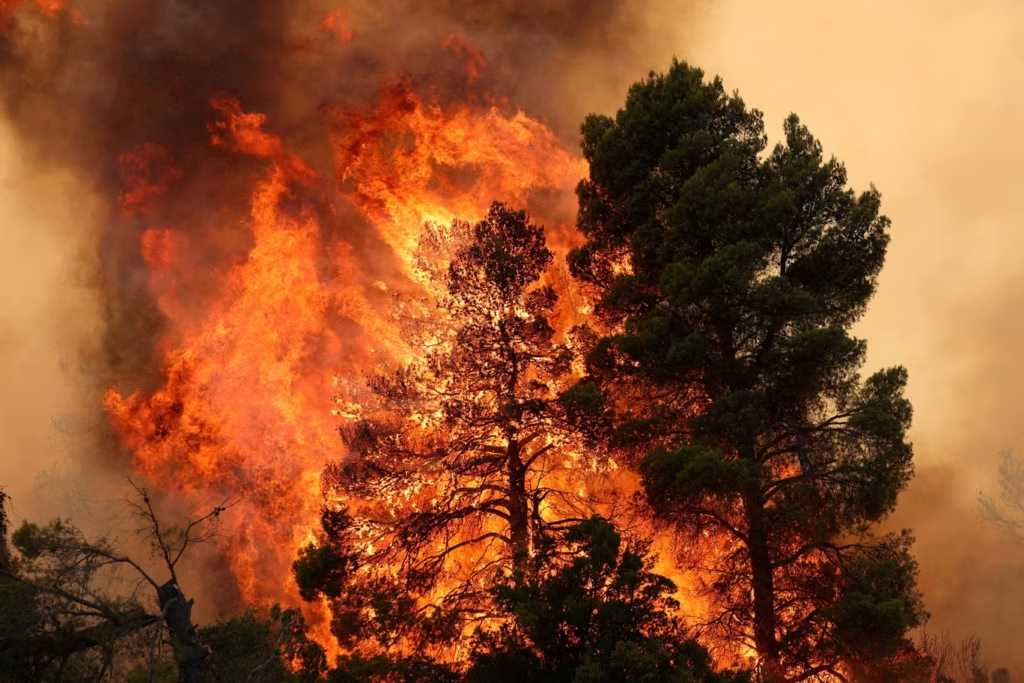
Cover: via https://www.independent.co.uk/news/world/europe/europe-wildfires-in-numbers-heatwave-mapped-b3029483.html
X-Ray MIke || The future does not first become impossible when the water rises. It becomes impossible when no one will insure the roof, finance the repair, or rebuild what the water takes.
For most of industrial civilization, insurance has been treated as an afterthought: a bill attached to a house, a business expense, a clause in a mortgage agreement, a tedious piece of paperwork demanded before construction can begin. It is rarely understood as one of the quiet foundations of the modern world.
Yet insurance is the mechanism by which societies make catastrophe appear manageable. A home burns, a town floods, a warehouse is destroyed, a harvest fails, a hurricane tears through a coast: the loss is not supposed to remain with the person or business unlucky enough to suffer it. It is spread across a much larger pool. Premiums paid by many become reconstruction money for the few.
This arrangement depends on a basic assumption: disasters are exceptional. They occur in different places, at different times, and at a frequency that can be priced. The insurer can calculate the risk, collect premiums, buy reinsurance against the worst losses, and remain solvent because most policyholders will not need to rebuild at once.
Climate breakdown is eroding that assumption.
Wildfires, floods, heat, drought, windstorms, sea-level rise, and convective storms are no longer merely isolated disruptions appearing on an otherwise stable map. They are becoming recurring conditions of life in expanding parts of the world. They are growing more correlated: heat strikes several food-producing regions; fires and drought affect multiple insurance markets; storms damage not only houses but the roads, substations, warehouses, hospitals, and water systems that make those houses habitable.
The insurance industry has noticed because it has no choice. In 2025, global insured losses from natural catastrophes reached $107 billion; 92 percent came from “secondary perils,” including wildfires, floods, and severe storms rather than the rare headline catastrophe. Swiss Re projects that, under a peak-loss scenario, insured losses could reach $320 billion in 2026.
This is not simply another warning about rising premiums. It is a warning about the hidden financial architecture of civilization. Insurance is the institution that turns a physical disaster into a survivable economic event. When it retreats, the cost does not disappear. It moves—onto households, municipal budgets, taxpayers, lenders, public insurance pools, and eventually the people least able to carry it.
The question is not whether insurance can adapt to climate breakdown forever. The question is who will be left holding the risk when it cannot. The insurance crisis is not waiting somewhere in the future. It is already visible in particular markets. The unanswered question is whether the late 2020s and early 2030s will turn scattered withdrawals, premium shocks, and residual-market expansions into a wider crisis of housing, infrastructure, and public finance.
The Price of a Stable Climate
Modern development was built upon an unspoken subsidy: a relatively stable climate.
Coastal cities expanded because storms were assumed to be intermittent. Suburbs spread into forests and dry grasslands because fire was assumed to be containable. Farms relied on historic rainfall patterns. Ports, railroads, power lines, reservoirs, sewage plants, bridges, and hospitals were designed around probabilities derived from a world that is disappearing.
Insurance did not create that world, but it helped make its expansion financially possible. A bank is more willing to lend against a house if the house is insured. A business can borrow to build a warehouse if the warehouse can be covered against fire, flood, and storm damage. A city can issue bonds for infrastructure if investors believe that the tax base, public assets, and local economy will survive foreseeable shocks.
The consequences of insurance retreat therefore travel far beyond the policyholder.
If insurance becomes unavailable, a mortgage can become harder to obtain or refinance. If a property cannot be insured, it becomes a weaker form of collateral. If collateral weakens, lending contracts. If lending contracts, housing markets soften, construction slows, and municipal tax revenue falls. The town then has less capacity to repair roads, maintain emergency services, upgrade drainage, strengthen the grid, or prepare for the next disaster.
The result is a feedback loop that looks, at first, like a minor affordability problem:
– Premiums rise.
– Some households reduce coverage or go without it.
– Banks reassess lending.
– Property values weaken.
– Public insurance pools expand.
– Local governments inherit more risk.
– Necessary adaptation is delayed because the tax base is eroding.
– The next disaster arrives in a community less able to absorb it.
Research already finds that higher insurance costs can affect both credit and housing values. An NBER analysis found average nominal premiums rising 33 percent from 2020 to 2023 and estimated that a reinsurance shock reduced 2023 home values by an average of $8,400. In the United States, households in the fifth of ZIP codes with the highest expected climate-related losses saw premium increases that outpaced inflation by nearly 15 percentage points between 2018 and 2022.
This is how climate breakdown becomes a balance-sheet crisis before it becomes an evacuation order.
Those with the wealth, mobility, and information to leave will often be best positioned to do so first. They can sell early, rent elsewhere, absorb higher premiums, buy elevated property, install backup power, or simply self-insure against losses. Those who cannot leave remain exposed to a more brutal arithmetic: a home that costs more to insure, is harder to sell, and may be worth less precisely because the risks around it have become clearer.
The old promise of homeownership—that a house is both shelter and a reliable store of wealth—begins to fracture. In vulnerable regions, a house can become something else: a declining asset attached to rising risk, a mortgage that outlives the market value of the building, an obligation from which wealthier owners can escape but poorer owners cannot.
The Public Inherits the Uninsurable
Private insurers do not withdraw from high-risk areas out of cruelty. They withdraw because the business model is to price risk, not abolish it.
That distinction matters.
When losses become too frequent or too concentrated, an insurer faces choices: raise premiums, narrow coverage, impose deductibles, reduce exposure, stop renewing policies, or leave the market. Regulators can slow some of these actions. Politicians can pressure companies to remain. But no regulation can force a private market to make recurring, predictable losses indefinitely without someone else subsidizing it.
That “someone else” is increasingly the public.
In the United States, state-enabled residual-market insurers—often called FAIR Plans—provide basic coverage for households and businesses unable to obtain it through ordinary private insurers. They were not designed to become the default risk warehouse for entire regions.
But this is what happens when the private market retreats while people, homes, and businesses remain in exposed places.
California offers a glimpse of the future. As of March 2026, the California FAIR Plan had nearly 684,000 policies, $750 billion in exposure, and more than $2 billion in written premium. Its exposure had grown 242 percent since September 2022. The numbers matter not because California is uniquely doomed, but because they show the sequence clearly: private insurers retreat; a residual-market backstop grows; that pool accumulates enormous exposure; and the eventual loss is redistributed across insurers, policyholders, and—if public aid follows—taxpayers.
The apparent solution—residual-market insurance backed by regulatory intervention—can be necessary. People need homes, businesses need coverage, and communities cannot simply be abandoned overnight. But an insurer of last resort is not a solution to worsening physical risk. It is a way of distributing that risk after private insurers have decided they cannot profitably bear it.
If a residual-market pool suffers losses beyond its reserves and reinsurance, costs must be passed somewhere: assessments on other insurers, higher premiums, state borrowing, taxes, reduced public services, or federal disaster aid. The risk returns to the public, only now it returns in a more concentrated and politically explosive form.
This is the last subsidy.
For decades, development in floodplains, fire-prone hills, eroding coasts, and storm-exposed regions was facilitated by an implicit collective promise: if disaster came, someone would pay to rebuild. Private insurance, public disaster assistance, federal flood programs, municipal bonds, and emergency appropriations together made that promise credible.
Climate change does not eliminate the need for solidarity. It makes solidarity unavoidable. But it also forces an uncomfortable question: should public money endlessly rebuild the same exposed assets while the underlying hazards worsen?
There are no painless answers. Refusing assistance means sacrificing people who may have had little control over where they lived or what risks were concealed from them. Rebuilding without conditions can subsidize the repetition of known danger. Relocation may be rational on paper but emotionally, culturally, and politically devastating in practice. It can also become a form of dispossession when poorer communities are moved while wealthy enclaves use public defenses, legal power, and private capital to remain.
The central danger is not that governments will help too much. It is that they will help selectively: protecting valuable property, strategic industries, affluent tax bases, and politically connected areas while allowing poorer households and weaker municipalities to become effectively uninsurable.
That is climate adaptation under inequality. Not a shared transition to safety, but a sorting process.
The Protection Gap Is the Map of Abandonment
The widening gap between economic losses and insured losses is often described in technical language: the “protection gap.”
It sounds harmless. It is not.
The protection gap is the portion of disaster damage that is not covered by insurance. It is the difference between a flooded shop reopening and remaining closed; between a family replacing a roof and living under tarps; between a damaged farm planting again and selling the land; between a city restoring services and entering a long fiscal decline.
Globally, poorer countries already carry the heaviest burden. Swiss Re estimates that 80–90 percent of catastrophe losses in emerging economies are typically uninsured. The World Bank similarly reports that disaster losses in developing countries are more than 90 percent uninsured on average.
Europe is not immune. Only around one-quarter of losses from extreme events in Europe were insured from 1980 through 2024, according to the European Insurance and Occupational Pensions Authority. Its 2025 Eurobarometer found that only 17 percent of respondents had coverage for property damage from natural catastrophes.
The temptation is to interpret this as a failure of consumer choice: people should have bought more coverage. But this misunderstands the problem. Insurance cannot close the gap if premiums exceed what people can afford, if insurers will not offer the policy, if coverage excludes the very risk that threatens the property, or if the household is too poor to insure an asset that is already barely secure.
The market solution to uninsurability is often to price people out. The political solution is often to create underfunded emergency pools after the market leaves. Neither is the same as reducing the physical danger.
The meaningful response must begin earlier: stronger building codes, flood defenses, wildfire management, resilient power systems, heat protection, water infrastructure, land-use restrictions, managed retreat where necessary, and public support for households that cannot fund adaptation themselves. These measures can reduce expected losses and preserve insurability. Insurers, regulators, and international institutions all acknowledge that risk reduction is essential to keeping coverage available.
But adaptation has a finance problem of its own.
A wealthy homeowner may harden a roof, install fire-resistant materials, elevate a building, add drainage, buy a generator, or move. A wealthy city may construct flood barriers and modernize stormwater systems. A poor household may lack the savings to repair existing damage, much less pay for resilience upgrades. A poor municipality may be trapped between debt, aging infrastructure, and shrinking tax revenue.
This produces a cruel inversion. The places that most need adaptation often have the least capacity to finance it. And the less they can adapt, the more expensive insurance becomes. The more expensive insurance becomes, the less capital flows into the place. The less capital flows in, the harder adaptation becomes.
The insurance market then does not merely measure vulnerability. It can magnify it.
Infrastructure Cannot Buy Its Way Out
The insurance crisis is usually discussed through homeowners: Florida roofs, California fires, coastal flooding, rising premiums. But the deeper threat lies in infrastructure.
A civilization is not a collection of houses. It is a mesh of systems that allow houses to remain livable: electricity, water, sewers, roads, bridges, ports, railways, hospitals, telecommunications, schools, warehouses, emergency services, and food distribution.
All of these systems face climate risk. All depend, directly or indirectly, on insurance and finance.
If a water utility cannot insure critical assets, it may pay more to borrow. If a port faces repeated flood or storm damage, shipping becomes costlier and more uncertain. If warehouses, cold-storage facilities, transport networks, and food processors face rising premiums or exclusions, the cost passes down the supply chain. If municipalities face repeated losses, they may postpone maintenance just when infrastructure needs reinforcement.
This is how a climate disaster becomes a supply-chain problem, then a food-price problem, then a public-health problem, then a political problem.
A 2026 survey on infrastructure insurability found 96 percent of respondents highly concerned about long-term insurance challenges in climate-vulnerable regions. That concern is rational. Infrastructure often has a life measured in decades. It cannot relocate easily. A bridge, water-treatment plant, railway, or electrical substation is built in a specific place and expected to serve a community through many future conditions.
When the climate assumptions embedded in its design no longer hold, the question becomes not simply how to repair it, but who will finance replacement at a higher standard.
Industrial civilization has spent generations treating maintenance as an expense to defer. Roads are patched rather than rebuilt. Water systems leak. Electrical grids are extended without enough redundancy. Public budgets favor visible new projects over the unglamorous labor of repair. Aging infrastructure, limited resources, and deferred maintenance are already widely recognized problems; climate extremes turn this neglect into compounding risk.
The insurance system cannot solve that. It can only signal the price of failure—sometimes before governments are politically prepared to hear it.
A Managed Retreat From the Social Contract
There is a comforting story about insurance markets. As risks rise, the story goes, prices send a signal. People move away from danger, builders adapt, governments invest in resilience, and the market guides society toward a more rational distribution of resources.
This is only partly true.
Prices can signal risk. But they do not distribute the capacity to respond to it.
A premium increase may encourage a wealthy household to fortify its home. It may force a working-class household to drop coverage. A rising coastal insurance bill may persuade an investor to sell early; it may trap a retiree whose home is most of their wealth. A bank may stop lending in a high-risk area; it may do so after decades of lending helped build that area, and after residents have organized their lives around it.
The market calls this risk adjustment. For people living through it, it can feel like abandonment.
This is why the insurance crisis should be understood as a crisis of the social contract. Insurance always contained a moral claim as well as a financial one: that catastrophic loss would be shared, that a household would not be ruined by one fire or storm, that rebuilding was possible. As climate risks multiply, that claim is being renegotiated without public consent.
The wealthy will increasingly purchase protection: hardened homes, private fire mitigation, backup power, water storage, higher deductibles, elite insurance products, multiple properties, and mobility. Corporations will diversify assets, buy reinsurance, move operations, and pass costs to consumers. States with deep pockets will protect strategic districts and valuable infrastructure.
The rest will receive a more conditional promise: a high deductible, narrower coverage, delayed aid, a public plan with limited protection, an evacuation order, a disaster loan, or the suggestion that they should have prepared better.
This is not an argument against insurance. It is an argument against pretending insurance can substitute for a livable climate, public adaptation, and a just distribution of risk.
The physical problem cannot be priced away. A floodplain does not become safe because its premiums are actuarially accurate. A burning forest does not become manageable because a reinsurer recalculates the model. A city cannot insure itself out of heat, drought, sea-level rise, or decaying infrastructure.
Insurance can help households recover from shocks. It can reward risk reduction. It can finance rebuilding and reveal danger that property markets have ignored. But it cannot carry indefinitely the losses of a society committed to building, extracting, and concentrating wealth as though the old climate still existed.
The Future Becomes Selective
The darkest possibility is not a universal collapse in which every place fails at once.
It is a selective future.
Some regions will receive flood walls, fire suppression, upgraded grids, subsidized insurance, functioning hospitals, protected supply chains, and rapid reconstruction. Other regions will receive rising premiums, withdrawn coverage, emergency declarations, delayed checks, disaster loans, and eventual neglect.
Some families will treat climate risk as a portfolio decision. Others will experience it as the loss of the only asset they own.
Some companies will turn volatility into a business model. Reinsurers, private-equity landlords, security firms, data companies, defense contractors, commodity traders, and infrastructure investors may all find opportunities in a world where public systems retreat and risk is redistributed downward.
The line between a protected zone and a disposable one will not always be marked by a wall. It may be marked by whether a mortgage is available, whether a hospital remains open, whether a school can be repaired, whether a water utility can borrow, whether an insurer writes a policy, and whether a family can stay after the next disaster.
That is why insurance deserves to be seen not as a technical side issue but as one of the places where climate breakdown becomes social reality.
The final crisis will not begin when insurers discover that risk has become expensive. They already know that.
It will begin when rebuilding after disaster is no longer a public promise, but a luxury purchased by those wealthy enough to insure what remains.
Discover more from Class Struggle Ecology
Subscribe to get the latest posts sent to your email.